
Watching Moscow maneuver around Trump is like witnessing a master class in manipulation. As political analyst Mykola Riabchuk argues, the Kremlin’s calculated use of 'reflexive control' has given it a new way to tighten the screws on Ukraine while leaving Europe scrambling to catch up.
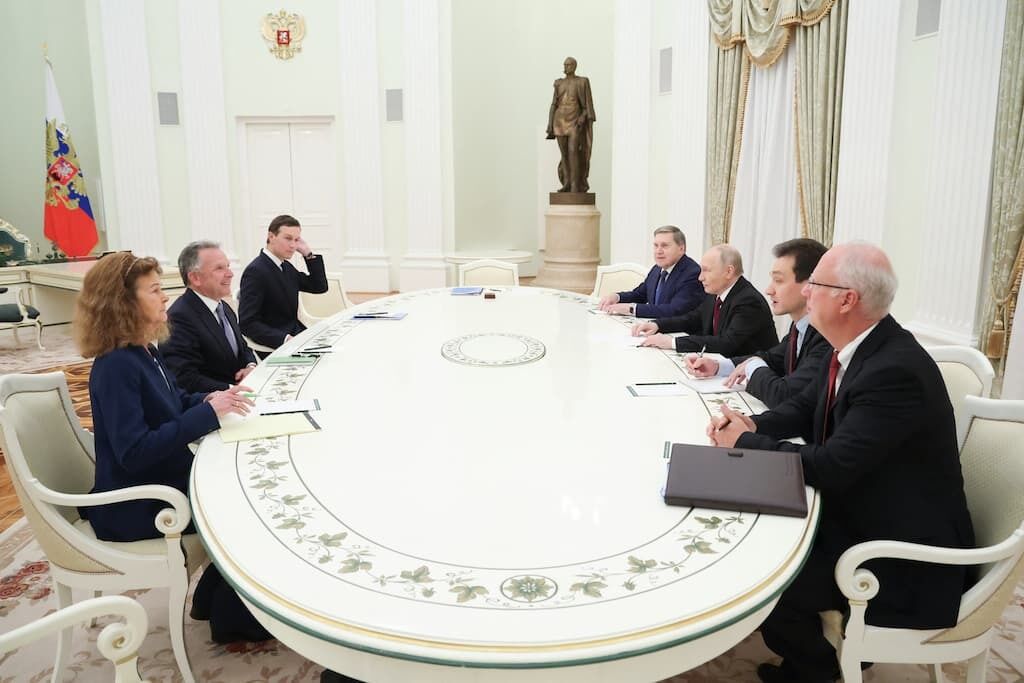 Russia's President Vladimir Putin, accompanied by Kremlin economic envoy Kirill Dmitriev and Kremlin aide Yuri Ushakov, meets with US special envoy Steve Witkoff and US President Donald Trump's son-in-law Jared Kushner at the Kremlin in Moscow on December 2, 2025. Photo: ANP / Alexander KAZAKOV / POOL / AFP
‘Reflexive control’ is a technique in which one side deliberately shapes the information and motivations available to an opponent, so that the opponent makes decisions that harm their own interests. A skilled actor can nudge their enemy toward choices that look rational from their perspective, but are strategically wrong. A classic illustration appears in Uncle Remus’s tales, where Brother Rabbit tricks Brother Fox: the rabbit begs the fox not to throw him into the briar patch, prompting the fox to do exactly that and give the rabbit what he wants.
Nowadays, one may find a better example of reflexive control in the so-called ‘28-point peace plan’ submitted to Kyiv and Moscow on Trump’s behalf by his special envoy and long-time business partner Steve Witkoff. The first readings of that plan left no doubt about its Moscow origins. It had ‘Russian fingerprints all over it’, as several commentators remarked. Even US Foreign Minister Marco Rubio called it ‘unacceptable’, although he eventually backpedaled from his initial criticism. ‘This is not a plan for peace’, Christian Caryl, the former Moscow bureau chief for Newsweek summed up his close analysis of the document. ‘It is a plan for Russian victory and Ukrainian capitulation. The spirit of 1938 has been resurrected’.
The ‘spirit of 1938’ alludes here to the notorious Munich agreement signed by the UK, France, and Italy with Nazi Germany that forced Czechoslovakia to cede parts of its territory to Hitler. It allowed Hitler to further dismantle and occupy the country and, eventually, the whole of Europe. Since then, ‘Munich’ has become a popular metaphor for political cynicism and betrayal, and is broadly employed today by various commentators to describe Trump’s ‘peacemaking’ policy vis-a-vis Ukraine. Thomas Friedman of the New York Times suggested - with tongue in cheek - that the US president should be distinguished with the 'Neville Chamberlain Peace Prize' instead of the Nobel peace prize he covets so much. The former British prime minister Chamberlain is referred to here as the main architect of the ‘Munich deal’.
If Trump’s 28-point peace plan is forced on Ukraine without revisions, Friedman maintains, ‘we will need to add a new verb to the diplomatic lexicon: 'Trumped' — to be sold out by an American president, for reasons none of his citizens understand (but surely there are reasons)’.

Leaked conversations
The story became even more scandalous a few days later, after Bloomberg revealed the audio recordings of conversations between Witkoff and Putin's aide Yuri Ushakov, and between Ushakov and another Putin’s negotiator Kirill Dmitriev, the CEO of Russian Direct Investment Fund. The records firmly confirmed the Russian origins of the ‘plan’, which was already discernable before – not only from the document’s content, but also from its language, which was poorly run from Russian through an automatic translator.
In one conversation, Dmitriev and Ushakov conspire to manipulate an apparently ignorant and submissively pro-Russian Witkoff, inciting him to submit the Kremlin-baked ‘plan’ to Trump and present it as his own. ‘I think we'll just make this paper from our position’, Dmitriev says, ‘and I'll informally pass it along, making it clear that it's all informal. And let them do their own. I don't think they'll take exactly our version, but at least it'll be as close to it as possible’. In response, Ushakov agrees that Americans might not be so gullible; they could make some changes in the document and then claim that they were agreed with Moscow. ‘Well, that's exactly the point’, Ushakov says. ‘That's what I'm afraid of... They might twist it later, that's all. There is that risk’ [which after all is exactly what happened, red]. Dmitriev, however, is more confident and assures Ushakov that he would ask Witkoff to keep the wording ‘word for word’ and that everything would be done ‘neatly’.
Trump’s ‘envoy’ appears to play on the Kremlin’s side, teaching his Russian interlocutors how to better manipulate his boss
The earlier conversation between Ushakov and Witkoff is even more revealing and abhorrent. Here, Trump’s ‘envoy’ (with no diplomatic experience or regional expertise) appears to play on the Kremlin’s side, teaching his Russian interlocutors how to better manipulate his boss: just congratulate Mr. Trump, he says, on achieving the Gaza peace deal (reached shortly before that conversation) and praise him lavishly as a man of peace – i.e., massage his hubris and ego as much as possible.
In most governments, such revelations would have resulted in immediate firing of such ‘envoys’, but not in Trump’s. When asked about the scandal, he habitually attacked the journalists who allegedly undermine his peace efforts and then he declared that there was nothing unusual in Witkoff’s actions, it was arguably a ‘normal’ approach to negotiations: ‘That's a standard thing, you know, because he has got to sell this to Ukraine. He's got to sell Ukraine to Russia. That's what a dealmaker does’. This appears to be a Freudian slip of the tongue: Witkoff, in Trump’s reasoning, is selling to Ukraine something called ‘this’ (a bogus ‘peace plan’), while at the same time he is selling to Russia something much more substantial – ‘Ukraine’. And Witkoff himself strictly follows this logic. In the leaked conversation with Ushakov, he says: ‘Now, me to you, I know what it’s going to take to get a peace deal done: Donetsk and maybe a land swap somewhere’. Ukraine, indeed, is a little more than a ‘real estate chip being traded over cigars at Mar-a-Lago’, as the Canadian-American journalist Diane Francis recently wrote.
The Kremlin’s win-win game
Long before Moscow’s shenanigans became obvious to a general public, the sharpest experts had already aptly assessed the ‘plan’ as another Moscow trick. It is a smokescreen, aimed to detract attention from the genocidal war in Ukraine, from daily destructions and killings, to imitate some ‘peace process’ and readiness for a ‘negotiated solution’. It is designed ‘to soften Washington’s position by demonstrating that Russia “has something to give in financial terms” to the United States and people in President Donald Trump’s circle’, to avoid any new sanctions prepared by the US Congress, to prove that the essentially terrorist Russian state in fact has a ‘peace loving’ nature. This plan puts the ball, i.e. the blame and responsibility for the continued war, on Ukraine’s side.
And since the ‘plan’ officially came not from Moscow but from Washington, Moscow had no commitments vis-a-vis that plan: it contains some very good positions, they said, that could be used as a base for further negotiations. Which means that even if Kyiv and Washington fully accept the ‘plan’, Moscow would still be ‘improving’ the text until it fully accommodates the Kremlin's imperialistic whims. The ensuing statements of Russian officials leave little doubt on the scope and direction of the desired ‘improvements’: ‘the goals of our “special military operation” in Ukraine has not changed’. In other words (if you go beyond Putin’s euphemisms and read carefully his trusted ideologues), Ukraine should be erased from the earth as both a sovereign state and as a distinct nation under the sham slogans of ‘demilitarization’, ‘denazification’, and the ‘reeducation’ of Ukrainians ‘back’ into Russians.
The Kremlin’s fraudulent ‘plan’ laundered via the useful idiots as allegedly ‘American’ is really a perfect example of reflexive control: international media, experts, and politicians rushed to discuss a document which even its authors did not take seriously (hence why there are so many obscurities, incoherencies and absurdities in the text).
Luckily, not everyone bought this document at face value. The day after the ‘plan’ was published, James Sherr of Chatham House opined sarcastically that Moscow confirmed once again its ‘talents at “painting a picture” that induces us to “initiate” the very steps that Russia wants us to take’. Julia Struck of the Kyiv Post has also discerned a familiar pattern: ‘a Russia-origin proposal is laundered through Western media and figures close to Trump, including Witkoff, who has appeared in previous failed “peace framework” attempts’. Finally, the British writer Edward Lucas perfectly summarized the criticism: ‘Badly drafted, one-sided, and machine-translated from Russian, the supposed 28-point peace plan should have been a laughing stock. Instead, it prompted anguish in Ukraine, panic in Europe, and frantic backpedaling by the bits of the US administration that understand maps, words, and diplomacy. All that was a fine result for Russia. A clever leak highlighted and aggravated our divisions and weaknesses’.
Moscow confirmed once again its ‘talents at “painting a picture” that induces us to “initiate” the very steps that Russia wants us to take’
It is really appalling that so many experts and politicians still fail to understand the obvious: that Moscow is not interested in any negotiations and compromises insofar its ultimate goal is the final solution of the Ukrainian question: Ukraine’s destruction and subjugation. The Russian interest in the ‘peace process’ is very peculiar: they support it only to a degree to which it brings them closer to the sacred initial goal of the 'special military operation'. If the process results in Ukraine’s ‘peaceful’ capitulation under Trump’s heavy pressure, it would be perfect – though very unlikely. But if the sham peace process merely buys the Russians more time, cover, and capacity to achieve their primary goal by military means, it would be also fine and worth the spurious ‘peacemaking’ efforts.
Ukraine’s prospects
Ukrainians have very limited space to maneuver in this situation. They have learnt, since February, that it would be futile to appeal to notions of justice, morality, solidarity or international law just because these categories do not exist in Trump’s universe. They learnt, with Europeans’ help, that if somebody believes he is a Napoleon, it would be better not to dissuade him from that belief but, rather, persuade him to go together against Wellington, or Kutuzov, or Alexander I. They learnt to say ‘yes, Sir’, to hide their agenda in a humble ‘but’ after a well-behaved ‘yes’. They did not call the Witkoff-Dmitriev plan the bulls*** that it is, but instead thanked Mr. Trump once again (and keep on thanking him recurrently) for his peace efforts, while completely reworking, together with their European partners, that same ‘plan’ into something more feasible. The new, more feasible proposal is then predictably rejected by Russians, without any discussion.
As protracted negotiations between Trump’s and Zelensky’s representatives in Miami about a new plan brought no breakthrough, and the visit of Trump’s envoys to Moscow ended up with their spectacular humiliation in the Kremlin (though still stubbornly not recognized by Trump, who prefers to put all the blame on Zelensky), the peace talks have apparently reached the point where all the parties raise the stakes with the hope that their rival will blink first. Ukraine has been cheated by Russia and betrayed by its allies so much throughout its history that it can hardly accept any deal without ironclad security guarantees. And it cannot cede territories which Russia failed to occupy in the last four brutal years of war. Russia cannot accept anything less than Ukraine’s defeat and subordination. And Trump cannot accept anything that may hinder his envisioned business with Moscow, but he is also reluctant to undermine his own peacemaking image and Nobel Peace Prize prospects if he blatantly sacrifices Ukraine. So far, this ‘peace process’ is beneficial for Moscow but increasingly harmful for Ukraine.
Kyiv still has some cards, even though they are very few and not very strong: Ukrainian society is exhausted and bleeding, but remains resilient; Europe is divided and preoccupied with domestic issues but still committed to what they call European values and support for Ukraine; the American people and American Congress are increasingly critical of president Trump and have a rather favorable attitude toward Ukraine while maintaining an unfavorable position toward Russia; and, ironically, Mr. Trump’s bizarre obsession with the Nobel Peace Prize remains unachievable if he throws Ukraine under the Russian bus. But still, the business interests of President Trump and his partners seem to prevail, putting Ukraine in a precarious situation and forcing its president to frantically seek help in European capitals.
Mr. Trump’s bizarre obsession with the Nobel Peace Prize remains unachievable if he throws Ukraine under the Russian bus
Sadly enough, only America has a full set of cards to bring the ongoing Russian-Ukrainian war to a close. They may either deliver a full victory to Russia (Moscow’s first-best option), help Ukraine to reestablish its territorial integrity within internationally recognized borders (Ukraine’s first-best option), or freeze the conflict at the current frontlines and enforce the ceasefire for years to come. The first option is the easiest, since it does not require much effort or any resources – it will suffice to just abandon Ukraine, stop any assistance, and lift all sanctions from Russia. But this may have very serious political repercussions for Trump himself, for his party, and for America in general. The second option is the most difficult, since it requires very consistent and comprehensive military assistance for Ukraine, which is hardly available or affordable insofar as Ukraine does not belong to the sphere of vital interests of the U.S. The third option looks to be the most feasible and realistic. It may require more military assistance, but the main instrument here is (the threat of) economic sanctions, including secondary sanctions, and their tough and coordinated enforcement. The main problem here is cognitive: the incumbent American leadership must recognize something which is quite obvious to most Ukrainians and many Europeans: Russia will not stop until and unless it is stopped – by force, not by any ‘negotiations’.
So far, Russia is spectacularly successful in exercising its reflexive control over the American president, thereby exploiting his three major vulnerabilities: greed (corruption), vanity (narcissism), and ignorance. It seems that Ukrainians and Europeans are trying to develop their own methods of reflexive control, but since they are much more constrained in both moral and political terms, the battlefield is certainly not level. As a result, the outcome of this battle is hardly predictable.
10 jaar RAAM: wij hebben uw hulp nodig
In 2026 bestaat RAAM 10 jaar. Het is geen vanzelfsprekendheid dat we blijven voortbestaan. Daarvoor hebben we uw hulp nodig. Met uw giften kunnen wij auteurs een bescheiden honorarium betalen, onderzoek doen en Kennisplatform RAAM overeind houden. Wij zijn een ANBI: uw gift is aftrekbaar van de belasting.


