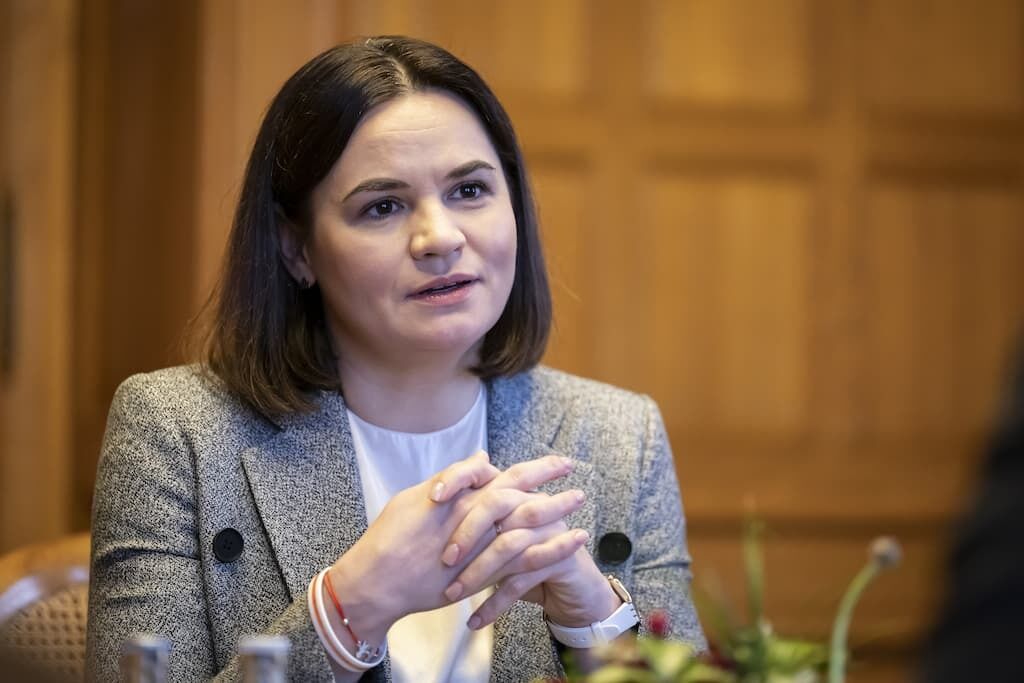
On Friday, October 17, 2025, Sviatlana Tsikhanouskaya, leader of the democratic Belarusian opposition against dictator Alexander Lukashenka delivered RAAM's ninth October Lecture in the Rode Hoed in Amsterdam. This is the full text of Ms Tsikhanouskaya's lecture, titled 'Caught between Russia, Ukraine and NATO: The Belarusians’ existential struggle for their country’s survival'. A recording of her speech and the subsequent conversation can be found below and on YouTube.
 Sviatlana Tsikhanouskaya delivers RAAM's ninth October Lecture in Amsterdam. Photo: Sviatlana Tsikhanouskaya's Office
Dear friends!
It’s an honor for me to speak here in Amsterdam, at this beautiful former clandestine church, which became a symbol of Freedom of Thought.
In today’s Belarus, any kitchen or private house where people gather to discuss the latest news, to read Belarusian books, to learn Belarusian language or to sing folk songs, is a space of free thought: a space of resistance.
Free thinking is considered 'extremist' in Lukashenka’s Belarus. It can get you in prison. And I dream of a time when there will be fewer prisons in Belarus, and more places like this one.
I thank Platform RAAM for the invitation, and I thank you all for your interest in Belarus. I’m glad that our part of Europe, which long existed in the shadow of Russia, has become closer to the West. I’m not glad that it is happening under such tragic circumstances as war in Ukraine.
In Western Europe, due to Lukashenka’s pro-Russian politics, Belarus is often perceived as a part of Russia. But what if I told you that Belarus is a country with a long European tradition? A forgotten Europe?
Did you know that the modern Cyrillic alphabet was created here, in Amsterdam? It was designed by a Belarusian protestant called Illya Kapievich, in the early 1700s. He worked as a publisher here, printing books with both Latin and Cyrillic letters. When the Russian tsar Peter the Great met Kapievich, he asked him to also print grammar books in Russian, so that Russians could learn their language too. At that time, the Belarusian bookprinting tradition was already two centuries old, dating back to the Renaissance.
Belarus, then part of the Polish-Lithuanian Commonwealth, was a country much more advanced than Russia – economically, culturally and politically. Belarusian nobles, together with Polish and Lithuanian ones, elected their kings in a democratic way. Like the Dutch, we used to live in a democratic monarchy. Our Statute of 1588, written in Belarusian, was an inspiration for the first European constitution, the Polish one, adopted in 1791.
In short, Belarus is not Russia. Never has been. Belarus is Europe.
After seventy years of Soviet occupation, Belarus regained independence in 1991. But the period of freedom was short. A man with a dictator’s ambitions came to power and turned Belarus away from the path of democracy. 'I won’t lead my nation where the civilized world goes', he famously declared. That was probably the only political promise that he ever fulfilled.
Today’s Belarus is an odd mixture of Soviet legacy and European spirit. An Italian journalist called it 'communism with a taste of cappuccino'.
10 jaar RAAM: wij hebben uw hulp nodig
In 2026 bestaat RAAM 10 jaar. Het is geen vanzelfsprekendheid dat we blijven voortbestaan. Daarvoor hebben we uw hulp nodig. Met uw giften kunnen wij auteurs een bescheiden honorarium betalen, onderzoek doen en Kennisplatform RAAM overeind houden. Wij zijn een ANBI: uw gift is aftrekbaar van de belasting.
Sometimes, it feels that Belarus is stuck in time. Where else could you find a McDonald’s right next to a KGB – yes, still called KGB – prison for political hostages? A modern Tesla parking near Soviet-time Lenin monuments? And this hypocrisy is everywhere.
If you don’t look deeper behind walls, you won’t even differentiate dictatorship from a normal country. Dictators are usually masters of wrapping outdated goods in brand new packages.
Squeezed between West and East, the EU and Russia, Belarus has always been on the frontline, between democracy and tyranny, in the center of wars, repeated clashes of civilizations.
But never before was the question of our geopolitical choice so pressing as it is now.
The pro-Russian regime of Alexander Lukashenka, having ruled Belarus for 30 years, chose Russia, and traded away Belarus’s independence in exchange for Moscow’s political protection.
 People attend a protest march against the results of the presidential elections, in Minsk, Belarus, 23 August 2020. Photo: ANP / EPA
His system has survived not on innovation or competitiveness, but on cheap Russian oil and gas, and endless loans from the Kremlin.
For 30 years, Lukashenka has mastered the art of playing geopolitical seesaw.
We often joke that in winter, he becomes 'pro-Russian' to secure cheaper resources, while in summer he suddenly turns 'pro-Western' to get financial assistance from the EU and US.
To suppress those who disagree, he has built a Soviet-style system of repression and fear. His political opponents have been murdered, imprisoned, or driven into exile. But first of all, everything started with silencing the media – so that no one knew for sure what was happening.
For three decades, Belarus was a black spot on the map of Europe, forgotten and isolated.
Too often, behind Lukashenka, the world fails to see the best of Belarus: its people.
While the dictatorship was building its prisons and police stations, building a totalitarian state – society developed its own way, western way, European way.
Belarusian society has outgrown the dictator
Belarusian society has outgrown the dictator. Five years ago, we saw its blooming on the streets of Belarus. When millions of Belarusians rose up against dictatorship.
And this is where my story started. I was an ordinary woman, bringing up two children.
When my husband, a blogger, ended up in jail after announcing his presidential ambitions, I decided to run in his place.
When your loved ones are in danger, you don’t wait for someone else to act. You stand up.
The regime registered me as a candidate – as a joke. 'Our Constitution is not for women,' Lukashenka said. But that joke became his fatal mistake.
 Protest sign against Lukashenka after he claimed victory in the 2020 presidential elections. Photo: Yauhen Yerchak / ANP / EPA
We WON that election, with more than 60%. Even the savvy dictator could no longer hide this truth. We organized an alternative vote count that proved our victory.
The regime stole our victory – but the people said 'No.' In every city, people took to the streets. Not just politicians. Factory workers. Students. Nurses. Priests. Grandmothers. Teenagers. They came holding flowers. Holding each other. And chanting one word: Enough.
But like every dictator, Lukashenka refused to step down. Supported by Putin, he unleashed brutal terror that Europe hadn’t seen for decades.
Thousands were beaten, arrested and tortured, dozens killed. Hundreds of thousands had to flee.
This terror continues to this day. As we speak, every single day, ten to fifteen people are being detained.
Moreover, the dictator dragged Belarus into the Russian war against Ukraine, of course against the will of the Belarusian people.
Nine million people were taken hostage by two aging dictators
It was from Belarus that Russian tanks rolled toward Kyiv. It was from Belarus that the first Russian missiles flew to hit Ukraine. Our country became a launchpad for war, while nine million people were taken hostage by two aging dictators.
Meanwhile, Belarusians quickly mobilized to help Ukraine, organized sabotage against the Russian military, and many went to fight for Ukraine as volunteers.
We made our stance clear: we are against this war, and we stand with Ukraine.
Looking back from today’s perspective, I often think: if our uprising had succeeded in 2020, Russia’s invasion of Ukraine might have never happened—and history could have taken a very different course. Putin’s plan to restore the Russian empire could have been ruined.
In his chauvinist frenzy, the Russian dictator doesn’t see Belarus and Ukraine as independent nations. He wants Ukraine to be the same as Lukashenka’s Belarus: controlled and loyal. Otherwise Russia would lose its direct access to Europe and could no longer keep it under threat.
When Russian writer Sergei Lebedev spoke here last year, he talked about impunity. In Russia, Stalin’s crimes, such as famine in Ukraine, were never fully admitted nor openly condemned by the state.
And it’s the same story with Belarus. Lukashenka glorifies Stalin.
Each year, on the 29th of October, Belarusians commemorate our intellectuals – writers, scholars, politicians – who were executed at Stalin’s order in 1937. More than a hundred of them were shot during a single night. It’s called 'The Night of Shot Poets'.
These killings were never condemned by Lukashenka. Instead of commemorating the victims, he commemorates executioners. And continues what Stalin did: destroying our national identity.
 Sviatlana Tsikhanouskaya shows the audience a portrait of Nobel Peace Prize winner Ales Bialiatski, who is imprisoned in Belarus. Photo: Sviatlana Tsikhanouskaya's Office
Our Nobel Peace Prize Winner Ales Bialiatski is in jail. Another Nobel Prize Winner, Sviatlana Aleksievich, was forced into exile. Patriots like Raman Bandarenka, Vitold Ashurak or Ales Pushkin were killed. A dozen political prisoners lost their lives behind bars, due to torture or lack of medical assistance.
Those crimes were never prosecuted. But I’m sure that they will be, one day. Impunity is not an option.
It is naive to think we can split Putin and Lukashenka
Today, Lukashenka is selling Belarusian sovereignty to Russia for the sake of staying in power.
Lukashenka and Putin may hate each other, but they need each other. It’s a symbiotic relationship.
Without Putin, Lukashenka would not survive a single day, like a scuba diver without an oxygen tank. And it is naive to think we can split them.
It’s also naive to think that we can re-educate them, or appease them. Believe me: dictators don’t seek peace. They need war, because it fuels their regimes and serves as false justification for terror.
If Ukraine loses, it will be difficult to snatch Belarus from the claws of the Russian bear
Today, our fate largely depends on the geopolitical context. We understand that if Ukraine wins we will have another chance too. And if Ukraine loses, it will be difficult to snatch Belarus from the claws of the Russian bear.
In 2020, it seemed that everything depended on us. Today, Belarus has become a part of a bigger problem.
We can’t go to protest openly today, but we can prepare for a new momentum, and I am sure it will open a new window of opportunity for us.
We do everything we can to bring this moment closer.
I’m sure that Belarus can be a success story. This big story will be composed of little personal stories of every one of us. Some of them will go down in history.
Stories like that of Natallia Suslava, a professor of Russian literature from Homel University. Her son, volunteer Pavel 'Volat' Suslau, was killed by Russian aggressors in Ukraine. Natallia went there to become a true mother to his brothers in arms.
Stories like that of Maria Zaitseva, whose blood-covered face, in 2020, became one of the iconic images of police brutality in Minsk. After her wounds were healed, Maryia went to defend Ukraine and was killed in battle in January this year. Just one day after celebrating her 24th birthday.
 Maria Zaitseva, a Belarusian volntueer who was killed on the battlefield in Ukraine, just one day after her 24th birthday. Photo: Second International Legion of the Armed Forces of Ukraine
Stories like that of 69-years-old politician Mikola Statkevich, who spent 12 years of his life in Lukashenka’s prisons. When he was released a month ago, he refused to be deported to Lithuania and went back to Belarus. He rejected freedom in the name of his dignity and love of his country.
With people like this, I have no doubt that we’ll see the day when Belarus will be free.
Dear friends,
In conclusion, I would like to share several pieces of advice, and lessons learned during my short and accidental political career.
First, cherish what you have. Often, people living in a democracy take it for granted. But in countries like Belarus, or Ukraine, we know its true price—because we sacrifice everything for it.
Freedom is never guaranteed. It’s so easy to lose, and so hard to get back. It must be protected. Nurtured. Fought for, again and again.
Second: never stop looking for the truth. Never stop asking questions. Never stop learning. Keep an open mind and use the amazing tools available today. The goal of tyranny is to make you confuse truth and lies.
Third: never lose hope. Maybe, hope alone is not enough, but it’s something that keeps you afloat in the most difficult moments. Those who were recently released from Lukashenka’s prisons said it was only hope that helped them survive.
Fourth: listen to your heart as well as to your mind. Empathy, compassion, and solidarity is our greatest superpower. Sometimes life puts you in circumstances in which you just have to act. Don’t hesitate to do the right thing.
And finally: no fight can be won alone. You always need friends, you need allies. You need a common effort. The fight for democracy is not local, it’s a global one.
The greatest threat to democracy is not always violence. It’s often fear, doubts, fatigue, loss of hope. And simply forgetting who we are and what we stand for.
Let us renew our commitment to freedom. The Belarusian people have not given up. And neither should the democratic world.
Together, we will prove – once again – that the power of the people can change history.
Thank you. Zhyve Belarus!