
Migrant families in Russia face increasing discrimination as they attempt to integrate into society, writes anthropologist Vlada Baranova. Men are pressured into joining the army to fight against Ukraine, and their children now have to pass tough language tests before even being admitted into schools. The state systematically excludes people with a migrant background, reducing them to second-class citizens.
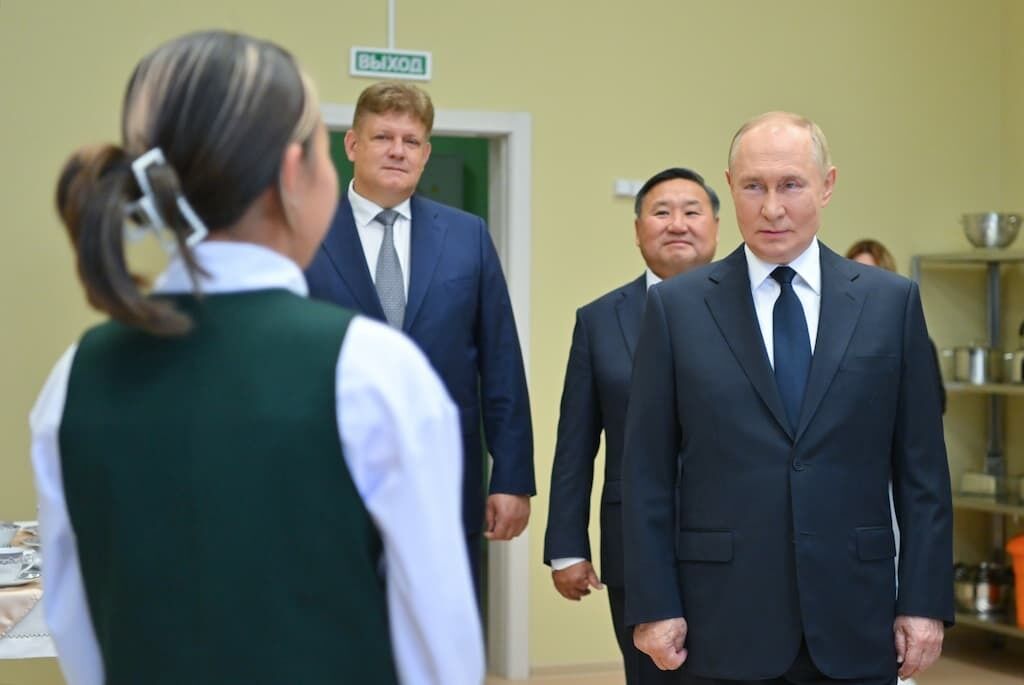 Russian President Vladimir Putin visits a secondary school in Kyzyl, the capital city of the autonomous republic of Tuva, Russia. Photo: ANP / EPA / Kristina Kormilitsyna / Sputink / Kremlin Pool
Since April 1, 2025, a new Russian law requires non-Russian citizens to pass a high-level language proficiency exam before being admitted to schools. Supporters of the law argue that it aims to improve the integration of migrant children into Russian society, by ensuring they have the language skills necessary to succeed in school. Critics, however, emphasize that it restricts access to education for non-Russian citizens and deprives them of the right to education guaranteed by the Constitution. It is just one of many ways in which the Russian government pressures and discriminates against migrants.
Why is migration a significant topic in public discourse during the war?
According to Human Rights Watch, Central Asian migrants working in Russia face ethnic violence, administrative restrictions, and arbitrary arrests. This has increased in recent years, especially after the terrorist attack on Moscow’s Crocus City Hall on March 22, 2024. Racist rhetoric continues to spread, promoted by officials and far-right movements and even evolving since the full-scale invasion of Ukraine. A coordinated media campaign has fueled a rise in hate speech on social media in 2024. In particular, people from Tajikistan, Uzbekistan, and Kyrgyzstan are affected by this xenophobia.
At first glance, it may seem odd that government officials and state media in a country at war would criticize migration so heavily. This also appears to contradict the labor shortage Russia is experiencing in the context of the war. After all, the country needs labor from abroad to fill gaps in the market. However, as the use of propaganda helps avoid addressing real issues, the emphasis on migration becomes more understandable. Amid war-related fear and anxiety, especially in cities targeted by drone attacks, public frustration is redirected toward migrants.
Migrants are also the focus of public discourse because they participate in the war. Foreign citizens are being recruited to fight, with the promise of high contract payments and expedited citizenship. In 2024, Putin signed a decree simplifying the path to Russian citizenship within one year for foreigners and their families who join the military. However, despite these economic and social incentives, many are unwilling to risk their lives, and voluntary participation among migrants is insufficient to meet the military’s manpower needs. As a result, human rights activists have reported an increase in complaints about contracts being signed by means of deception, or under threats of physical violence or criminal prosecution.
Pressure on migrants through bureaucracy
The civil rights advocate Valentina Chupik explains how migrants with limited Russian are deceived into joining the military: when filling in routine government forms, they are handed large stacks of paperwork in which Ministry of Defence contracts are hidden. The migrants are given little time to study these documents. Many do not understand what these forms are about, but sign them anyway. Another recruitment method involves conducting raids on mosques, markets, and hostels, ostensibly under the pretext of enforcing migration laws. Police detain migrants, often subjecting them to torture and coercion to pressure them into signing contracts with the Ministry of Defence. Those who have long lived in Russia and already obtained citizenship are issued military draft notices. Anti-migrant rhetoric from officials plays a role in the justification of raids and facilitating the recruitment process.
The authorities use bureaucracy to pressure migrants. Between 2023 and 2025, numerous new laws and amendments were adopted that have made life more difficult for migrant workers. These changes have made the migration process so complex that even migration experts struggle to keep up with the current regulations. For migrant workers, many of whom have limited Russian language skills and education, navigating these rules is even more challenging. The legal changes affect working conditions, registration rules, and the timing and requirements of mandatory medical examinations.
As a result of these changes, nearly every migrant is at risk of bureaucratic violations which lead to them being labelled as ‘illegal’. In February 2025, a register of ’controlled persons’ was introduced, targeting foreign citizens with expired visas, work permits, registration violations, or other offences. Being listed in this electronic register makes data on individuals' alleged infringement accessible to the public, including potential employers. It also results in the restriction of nearly all rights, and increases the risk of deportation – unless the individual agrees to resolve the issue by signing a contract with the military.
Restrictions on children from migrant backgrounds
Control over labor migrants has increasingly extended to their families. While this may seem irrational, especially in the context of Russia's demographic challenges, recent laws have significantly restricted the ability of second-generation migrants to integrate into Russian society, effectively making them into second-class citizens.
The most important change concerns access to education. Although education is a fundamental human right and is guaranteed by the Russian constitution, a new bill introduced mandatory Russian language testing at an extremely high level for school admission, along with stricter documentation requirements for the entire family. This bill was passed in December 2024, and came into force in April 2025. Even as a native Russian speaker and linguist, I found some of the questions challenging. However, the test itself is less of a barrier than the new application rules. Fewer than 20 percent of children who attempted to enroll in school under the new regulations were even allowed to take the test; the rest were turned away due to allegedly incorrect documentation or claims that no school places were available.
Even as a native Russian speaker and linguist, I found some of the questions challenging
According to an official from the Department of Education Oversight, as of June 2025, only 7 percent of children with foreign citizenship who wished to enroll in school managed to submit the required documents correctly and pass the exam. While most applications are typically submitted in August before the school year begins, it is unlikely that these numbers will improve significantly.
Language policy and non-Russian speaking children in schools
The law on language exams was passed in response to legitimate public concern about Russian language proficiency among students and broader issues of language policy. Schools lack integration classes and specialized lessons for non-native Russian speakers. Most teachers, including Russian language teachers, are unfamiliar with methods for teaching Russian as a foreign language, and struggle to support children with poor Russian skills.
Although there are non-profit organizations in Russia, such as ‘Children of St. Petersburg’, which help children learn Russian and prepare for school, these services are not available in all cities and have limited capacity. Volunteers typically work with only a small number of children. Private, paid options (such as courses or tutoring in Russian as a foreign language) are also scarce. When they do exist, they often provide inadequate training or do not work with children at all.
Following the introduction of the new rules in spring and summer 2025, demand for Russian tutoring for non-native speakers rose sharply. However, many migrant and refugee families cannot afford these services, even if their availability increases. As a result, opportunities for language adaptation among children from migrant backgrounds depend heavily on state-provided language support.
Integrative education programs in multilingual societies provided by the state are expensive and complex, requiring methodological expertise, substantial funding, and additional teaching staff. Even in countries with long-established programs, they are imperfect and frequently criticized. Nevertheless, they remain the only effective way to integrate children through education in the official language. In Russia, such programs barely exist at all.
Instead of developing and expanding regional integration programs, often implemented in cooperation with NGOs and schools, the authorities have opted to deny education to children without sufficient Russian language skills. This approach not only fails to address the problem of poor language proficiency but also creates segregation, excluding migrant children from the educational system altogether.
Financial and bureaucratic barriers for children
Language proficiency currently serves as the main barrier for the integration of second-generation migrants, but in the future families could also face financial barriers. In August 2025, a bill on paid school education for foreigners was resubmitted to the State Duma after having been previously rejected and returned for revision as unconstitutional.
Additionally, there are ongoing discussions among officials about linking schools and the national register of ‘controlled persons’ mentioned earlier. The government commission has already supported a bill requiring education authorities to transfer data on migrant children to the Ministry of Internal Affairs. If any bureaucratic irregularities are found, families could be added to the register and face penalties, meaning that even applying for school could pose serious risks for migrant families. In practice, this means that children from families without Russian citizenship are being denied access to education.
Terms such as ‘foreign citizens’ or ‘illegal migrants’ are used to justify violations of children’s language rights
Official discourse in Russia consistently singles out migrants as a distinct group. This framing channels public discontent toward ‘foreigners’, refugees, and migrants, who are portrayed as responsible for declining school performance due to the increasing workload on teachers and excessively large class sizes. Terms such as ‘foreign citizens’ or ‘illegal migrants’ are used to justify violations of children’s language rights, with the argument that their ‘home countries’ should educate them or that they are ‘lawbreakers’ undeserving of support.
Language policy in a multi-ethnic Russian society
A more constructive perspective would treat language rights within the framework of Russia’s multilingual society, regardless of parents’ citizenship. How does language policy address multilingual groups, both in supporting their native languages and in helping them learn Russian?
Russia is a multilingual country that officially seeks to protect the linguistic rights of different groups. For indigenous peoples, this includes the right to study in their native language or learn it as a separate subject. However, supporting minority languages is costly, and only about 37 of the 155 languages spoken in Russia are taught in schools. These opportunities have declined even further in recent years; in 2018, for example, amendments to the education law reduced the teaching of indigenous languages. Despite these changes, both official rhetoric and practice still recognize the language rights of indigenous peoples to some extent.
Little attention is paid to Russian citizens for whom Russian is not a native language. Although it is rare to find children born in Russia who do not speak Russian at all, proficiency levels vary by region and family background. Many children in Chechnya, Dagestan, or Tyva require additional Russian language support or bilingual teaching approaches. They also benefit from opportunities to study written forms and literature in their native languages.
Migrant and refugee children also need Russian language integration, alongside support for maintaining their family’s multilingualism. Considering language policy for all multilingual families — without dividing them into ‘locals’ and ‘migrants’ — would allow for the creation of integration classes, consultations with Russian language teachers, and support for native languages in schools or supplementary programs.
Current policy, however, treats diasporas with a migration background differently. Migrant children are excluded not only from discussions about supporting multilingualism and diversity but increasingly from access to school education itself.
10 jaar RAAM: wij hebben uw hulp nodig
In 2026 bestaat RAAM 10 jaar. Het is geen vanzelfsprekendheid dat we blijven voortbestaan. Daarvoor hebben we uw hulp nodig. Met uw giften kunnen wij auteurs een bescheiden honorarium betalen, onderzoek doen en Kennisplatform RAAM overeind houden. Wij zijn een ANBI: uw gift is aftrekbaar van de belasting.